
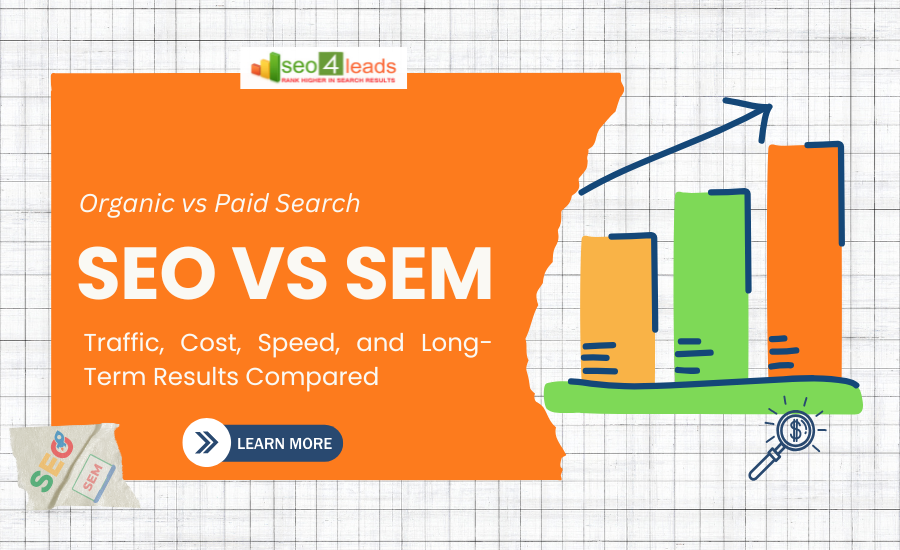
When businesses plan digital marketing, one question comes up almost every time: Should we invest in SEO or SEM?
If you’ve searched online for answers, you’ve probably seen confusing definitions, technical jargon, or one‑sided opinions. In reality, SEO vs SEM is not about choosing one and ignoring the other. It’s about understanding how each works, where they differ, and how they fit into your business goals.
This blog takes a practical, no‑nonsense approach to explain SEO and SEM, their differences, costs, speed, traffic quality, and long‑term impact—so you can make a smarter decision for your brand.
What Is SEO?
SEO (Search Engine Optimization) focuses on improving your website’s visibility in organic (non‑paid) search results on platforms like Google.
Simply put: – You don’t pay Google for each click – You optimize your website so Google chooses to rank you
Key elements of SEO
- On‑page SEO
- Content optimization
- Keywords placement
- Meta titles & descriptions
- Technical SEO
- Website speed
- Mobile friendliness
- Site structure & indexing
- Off‑page SEO
- Backlinks
- Brand mentions
- Authority building
SEO is not instant, but when done right, it builds a strong digital foundation for long‑term growth.
What Is SEM?
SEM (Search Engine Marketing) refers to paid search advertising, where you pay to appear at the top of search results.
The most common form of SEM is Google Ads.
In SEM: – You bid on keywords – You pay for every click (PPC – Pay Per Click) – Traffic stops the moment you stop spending
Common SEM formats
- Search ads (text ads on Google)
- Display ads
- Shopping ads
- Remarketing ads
SEM is designed for speed, visibility, and immediate traffic.
SEO and SEM Difference: Quick Overview
Before diving deeper, here’s a snapshot of the SEO and SEM difference:
- SEO is organic; SEM is paid
- SEO takes time; SEM works instantly
- SEO builds authority; SEM buys visibility
- SEO compounds over time; SEM resets when budget stops
Now let’s compare them properly across the factors that actually matter.
SEO vs SEM: Traffic Comparison
SEO Traffic
SEO traffic is: – Intent‑driven – More trusted by users – Consistent once rankings are stable
Users often skip ads and click organic results because they feel more authentic.
Best for: – Informational searches – Long‑term brand discovery – Content‑led businesses
SEM Traffic
SEM traffic is: – Immediate – Highly targeted – Volume‑driven
You can show ads exactly when users are searching for a product or service.
Best for: – High‑purchase intent keywords – Promotions and offers – Competitive industries
Verdict: SEO brings sustainable traffic, SEM brings on‑demand traffic.
SEO vs SEM: Cost Comparison
Cost of SEO
SEO does not charge per click, but it’s not free.
Costs usually include: – Content creation – Technical optimization – Link Building
However, once rankings are achieved: – Cost per lead reduces – ROI improves over time
Cost of SEM
SEM works on bidding.
Costs depend on: – Keyword competition – Industry – Quality score
Highly competitive keywords can cost a lot per click, and: – Every visit costs money – Budget exhaustion means zero traffic
Verdict: SEO is a long‑term investment, SEM is a continuous expense.
SEO vs SEM: Speed of Results
SEO Speed
SEO requires patience.
Typical timeline:
- First 1 2 months: groundwork
- 3–6 months: ranking improvements
- 6+ months: stable visibility
SEO rewards consistency, not shortcuts.
SEM Speed
SEM is instant.
You can: – Launch today – Get traffic today – Test keywords quickly
But speed comes at a cost.
Verdict: If speed is critical → SEM If sustainability matters → SEO
SEO vs SEM: Long‑Term Results
This is where the SEO and SEM difference becomes most clear.
Long‑Term Impact of SEO
- Traffic continues even without daily spending
- Rankings strengthen brand authority
- Content keeps working for years
SEO builds a digital asset.
Long‑Term Impact of SEM
- Traffic stops when ads stop
- Rising competition increases costs
- No lasting value without budget
SEM is powerful—but temporary.
Verdict: SEO wins for long‑term growth.
When Should You Choose SEO?
SEO is ideal if:
- You want long‑term online presence
- Your budget is limited but steady
- You want consistent leads over time
- You’re building a brand, not just sales
SEO is not about quick wins—it’s about future proofing your business.
When Should You Choose SEM?
SEM makes sense if:
- You need immediate leads or sales
- You’re launching a new product or service
- You’re running time‑sensitive campaigns
- You want quick market testing
SEM is excellent for short‑term performance goals.
SEO and SEM: Why the Smart Strategy Uses Both
Instead of thinking SEO vs SEM, successful businesses focus on SEO and SEM together.
A balanced strategy looks like this:
- Use SEM for immediate traffic and data
- Identify high‑converting keywords
- Build SEO content around those keywords
- Gradually reduce ad dependency
This approach: – Improves ROI – Reduces long‑term costs – Strengthens brand visibility
SEO builds the base. SEM accelerates growth.
Common Mistakes Businesses Make
Avoid these traps:
- Expecting instant SEO results
- Relying only on ads for years
- Ignoring landing page quality
- Not tracking conversions properly
Both SEO and SEM fail without strategy.
Final Verdict: SEO vs SEM
There is no universal winner in SEO vs SEM.
- SEO wins for trust, authority, and long‑term ROI
- SEM wins for speed, control, and immediate visibility
The real advantage comes when businesses understand the SEO and SEM difference and apply each at the right stage of growth.
If you’re serious about digital success, don’t ask which one is better—ask how to use both wisely.
FAQs: SEO vs SEM
1. What is the main SEO and SEM difference?
SEO focuses on organic rankings, while SEM relies on paid advertising for visibility.
2. Is SEO better than SEM for small businesses?
SEO is better for long‑term growth on limited budgets, while SEM helps with quick visibility.
3. Can SEO and SEM work together?
Yes. Using SEO and SEM together creates a balanced and high‑ROI digital strategy.
4. How long does SEO take compared to SEM?
SEO takes months to show strong results, while SEM can generate traffic instantly.
5. Should I stop SEM once SEO starts working?
Not necessarily. Many businesses reduce SEM spend gradually while maintaining SEO growth.
Need help choosing the right SEO and SEM strategy for your business? A well‑planned approach can save costs, increase leads, and build long‑term digital success.